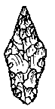
 Point Type: Squibnocket
Associated Date: 4200 - 3500 B.P.
Morphology: Stemmed
Length Point:
Ave: [ 37 +/- 6 mm]
Range: [ 22 to 51 mm]
Example: [ 35 mm]
Width Point:
Ave: [ 15 +/- 2 mm]
Range: [ 9 to 17 mm]
Example: [ 14 mm]
Point Ratio (Width/Length):
Ave: [.40 +/- .04 ]
Length of Stem:
(Maximum)
Ave: [ 15 +/- 2 mm]
Range: [ 13 to 17 mm]
Example: [ 14 mm]
Width of Stem:
(Maximum)
Ave: [ 12 +/- 2 mm]
Range: [ 9 to 13 mm]
Example: [ 11 mm]
Stem Length/Point Ratio:
(Length of Stem / Length Point)
Ave: [.41 +/- .04 ]
Stem Width/Point Ratio:
(Width of Stem / Width Point)
Ave: [.79 +/- .06 ]
Stem Ratio: Ave: [1.31 +/- .07 ] 1. Short (<= 0.7)
(Stem Length 2. Proportionate (> 0.7 & < 1.3)
/ Stem Width) 3. Long (>= 1.3)
Stem Form (Subjective):
1. Contracting 2. Parallel 3. Expanding 4. Asymmetric
Base Form (Subjective):
1. Convex 2. Straight 3. Concave
4. Notch 5. Lobe 6. Point
Blade Ratio: Ave: [1.5 +/- .2 ] 1. Lanceolate (>= 2.0 mm)
([Length Point 2. Isosceles (< 2.0 & > 1.2 mm)
- Length Stem] / Width) 3. Equilateral (<= 1.2 mm)
Blade Curvature: Ave: [1.2 +/- .2 mm] 1. Very Convex (>= 5 mm)
(Cord height of curve 2. Convex (< 5 mm & >= 2 mm)
from Shoulder to Tip) 3. Straight (< 2 mm & >= -2 mm)
4. Concave (< -2 mm)
5. Mixed (< -2 mm & > 2 mm)
Shoulder Angle: Ave: [151 +/- 5 o]
(Angle of Shoulder from
Tip to Shoulder to Shoulder Juncture)
Shoulder Juncture (Subjective): 1. Curve 2. Angle 3. Straight
Point Type:  Squibnocket
Associated Date: 4200 - 3500 B.P.
Morphology:  Stemmed

Length Point:
Ave: [ 37 +/- 6  mm]
Range: [ 22 to 51 mm]
Example: [ 35 mm]

Width Point:
Ave: [ 15 +/- 2  mm]
Range: [  9 to 17 mm]
Example: [ 14 mm]

Point Ratio (Width/Length):
Ave: [.40 +/- .04 ]

Length of Stem:
 (Maximum)
Ave: [ 15 +/- 2  mm]
Range: [ 13 to 17 mm]
Example: [ 14 mm]

Width of Stem:
 (Maximum)
Ave: [ 12 +/- 2  mm]
Range: [ 9  to 13 mm]
Example: [ 11 mm]

Stem Length/Point Ratio:
 (Length of Stem  / Length Point)
Ave: [.41 +/- .04 ]

Stem Width/Point Ratio:
 (Width of Stem  / Width Point)
Ave: [.79 +/- .06 ]

Stem Ratio:        Ave: [1.31 +/- .07 ]        		1. Short (<= 0.7)
 (Stem Length                                 		2. Proportionate (> 0.7 & < 1.3)
   / Stem Width)                             		3. Long (>= 1.3)

Stem Form (Subjective):
                1. Contracting   2. Parallel   3. Expanding   4. Asymmetric

Base Form (Subjective):
                1. Convex               2. Straight             3. Concave
                4. Notch              5. Lobe                     6. Point

Blade Ratio:       Ave: [1.5 +/-  .2 ]            		1. Lanceolate (>= 2.0 mm)
 ([Length Point                                     		2. Isosceles (< 2.0 & > 1.2 mm)
    - Length Stem] / Width)                        	3. Equilateral (<= 1.2 mm)

Blade Curvature:   Ave: [1.2 +/-  .2 mm]    	1. Very Convex (>= 5 mm)
 (Cord height of curve                       		2. Convex (< 5 mm & >= 2 mm)
  from Shoulder to Tip)                      		3. Straight (< 2 mm & >= -2 mm)
                                                   		4. Concave (< -2 mm)
                                                   		5. Mixed (< -2 mm & > 2 mm)
Shoulder Angle:    Ave: [151 +/-  5  o]
 (Angle of Shoulder from
 Tip to Shoulder to Shoulder Juncture)

Shoulder Juncture (Subjective):   1. Curve     2. Angle    3. Straight
© 1993 -
Tara Prindle